Current research areas
My research portfolio has one established mathematical center and three connected directions. Geometry-aware finite-element methods form the core. Constrained fields extend this work to the geometry of the unknown, geometric evolution provides demanding applications, and computational abstractions make the methods implementable and reusable.
Connections between the areas
The research questions cannot be separated completely. The admissible values of a tangential field depend on the geometry of its domain. Curvature may enter a surface PDE as a coefficient, or it may drive the motion of the surface itself. When the geometry is approximated, these connections affect consistency, stability, and the qualitative behavior of the computed solution.
Domain
Higher-order surface approximation makes geometric information available. The central analytical question is which combinations of metric, normal, and curvature errors actually enter a weak formulation.
Fields
Tangentiality, symmetry, trace, length, and manifold constraints can be represented exactly or approximately. Their interaction determines approximation quality, conditioning, and computational cost.
Evolution
Normals, curvature, and geometric measures become part of the unknown when a surface moves. Their discrete representation influences energy laws, conservation properties, and mesh quality.
A. Geometry-aware finite-element methods
How does the discrete representation of a domain enter a finite-element method, and which geometric information is actually required for accuracy and stability?
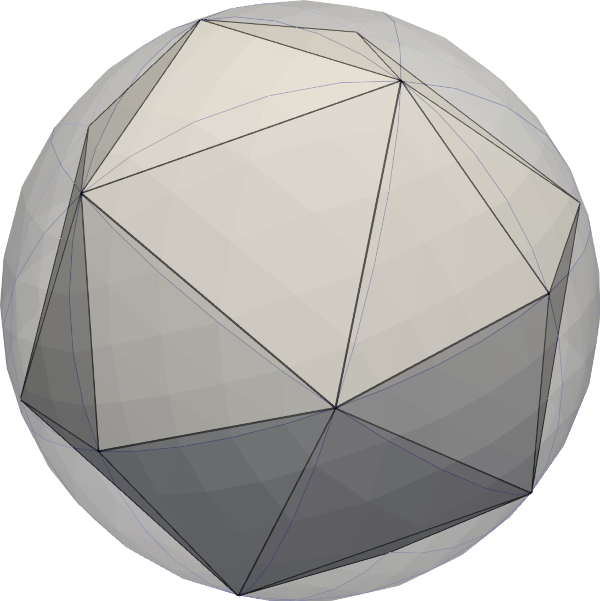
Surface finite-element methods approximate both a PDE and the curved surface on which it is posed. Classical estimates treat errors in position, normals, and curvature separately. In a variational formulation, however, these quantities occur in particular combinations. Leading errors can cancel, so the consistency error may converge faster than pointwise estimates suggest.
Established work
My work on dune-curvedgrid makes higher-order surface parametrizations available in DUNE. With Hanne Hardering, I analyzed tangential vector and tensor fields and surface Stokes discretizations on approximated surfaces. Our recent preprint on parity-dependent geometric consistency errors (see Hardering et al. 2026) explains why even-order geometry approximations can show unexpected superconvergence on suitably structured meshes.
Current themes
Current work studies stabilized reconstructions of mean curvature and the shape operator, including higher-order variants and comparisons with HHJ and Regge finite elements. See the curvature reconstruction project for details.
Questions ahead
Smooth geometric quantities satisfy identities such as the Gauss–Codazzi equations, but separately reconstructed discrete quantities generally do not. I am exploring whether useful discrete compatibility conditions can be identified and whether they improve approximation or robustness. This is a research direction, not yet an established theory.
B. Finite elements for geometrically constrained fields
Given several constraints, which should be encoded exactly in the finite-element space and which should be imposed approximately?
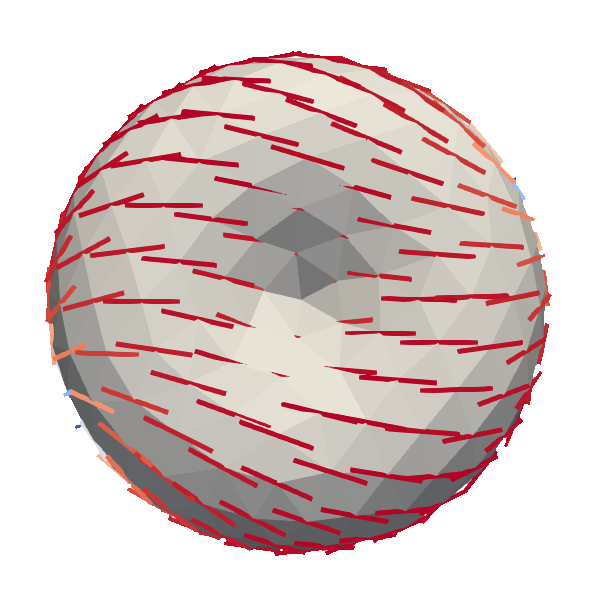
Surface liquid crystals provide a concrete motivation. Their vector or tensor order parameters may need to be tangential, symmetric, trace-free, of fixed length, or invariant under a head-tail symmetry. The broader numerical question applies to many PDEs whose unknowns take values in geometry-dependent spaces.
Established work
Earlier computational studies compared representations of orientational order on surfaces and extended them to symmetric tensor fields. Later analysis separated tangential and normal approximation errors and showed that optimal tangential estimates for penalty methods do not always require a higher-order normal. Current work on geometric surface finite elements combines an approximated surface domain with a manifold-valued range.
Current themes
The DFG project Symmetry, length, and tangential constraints compares complementary discretizations of tangential vector and tensor fields. See the constrained-fields project for the current questions and participants.
Questions ahead
Tangential fields are sections of a tangent bundle, since their admissible values change with position. Finite elements for sections of more general fibre bundles are a longer-term perspective. They would require a consistent treatment of both the approximated base surface and the changing target spaces.
C. Structure-preserving geometric evolution
How can a numerical scheme preserve the geometric and variational structures of an evolution equation while its domain changes?
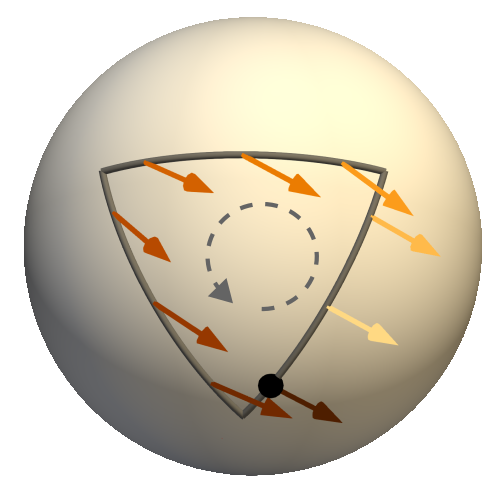
Geometric evolution is where domain approximation and constrained geometric quantities meet. Curvature, normals, and the shape operator may drive the motion, while the continuous equation may dissipate an energy or preserve volume. The discrete method should reproduce the relevant structure without hiding errors in the geometry approximation.
Established work
With Harald Garcke, Robert Nürnberg, and Ganghui Zhang, I developed higher-order isoparametric methods for mean-curvature flow and surface diffusion. The schemes retain energy stability, and the structure-preserving surface-diffusion method conserves enclosed volume. Our work on surface Minkowski tensors provides intrinsic, tensor-valued measures of rotational symmetry for shapes on curved surfaces.
Current themes
Current work considers the gradient flow of the squared Gaussian-curvature energy and the separate question of evolution controlled by surface Minkowski measures. See the geometric evolution projects for details.
Questions ahead
Longer-term questions include geometric evolution under nonclassical global constraints and the coupling of evolving geometry to constrained surface fields.
D. Computational abstractions for advanced finite elements
Which mathematical abstractions allow advanced finite-element methods to be expressed generically, efficiently, and in a form that can be reused?
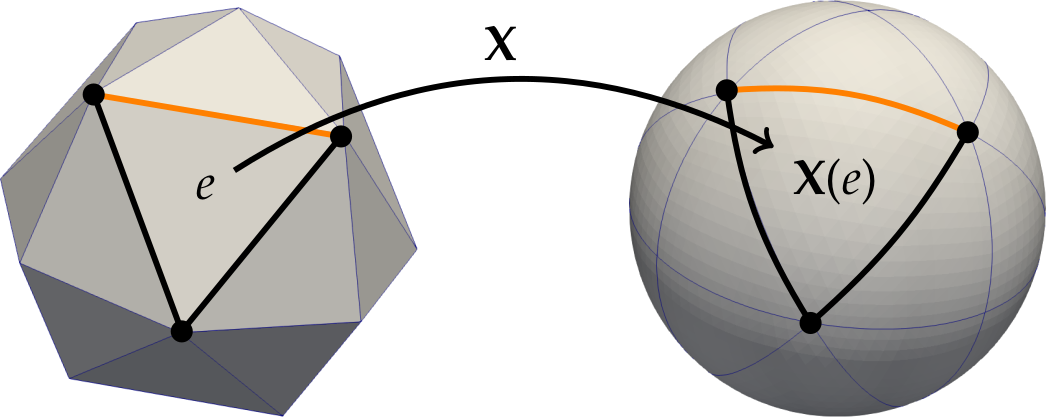
Software is not a separate final step in this research. The representation of a curved geometry or a tensor-valued finite element determines which methods can be formulated, compared, and maintained in practice. My long-term work as a core developer in DUNE and AMDiS provides the computational base for the other three areas.
Established work
I rewrote AMDiS as a DUNE module and contribute to DUNE’s core and extension modules. My work includes curved-grid representations, composed finite-element bases with tree-structured indices, periodic grids, mesh comparison, file formats, and tensor data structures. Several of these components have grown directly from research questions or supervised theses.
Current themes
Current development concerns higher derivatives of discrete geometries, tensor-valued data, transformed finite elements, generic element generation, and parallel indexing for composed spaces. See the DUNE infrastructure project for details.
Questions ahead
A framework for bundle-valued finite elements would need representations of fibres, distances, exponential and logarithmic maps or retractions, parallel transport, and their derivatives. The mathematical problem belongs to Area B. The task here is to find computational abstractions that express it without tying the implementation to one particular bundle or PDE.